
Beyond the Project: Why "People Are the Wealth" in the Future of Global Missions
Jan 19, 2026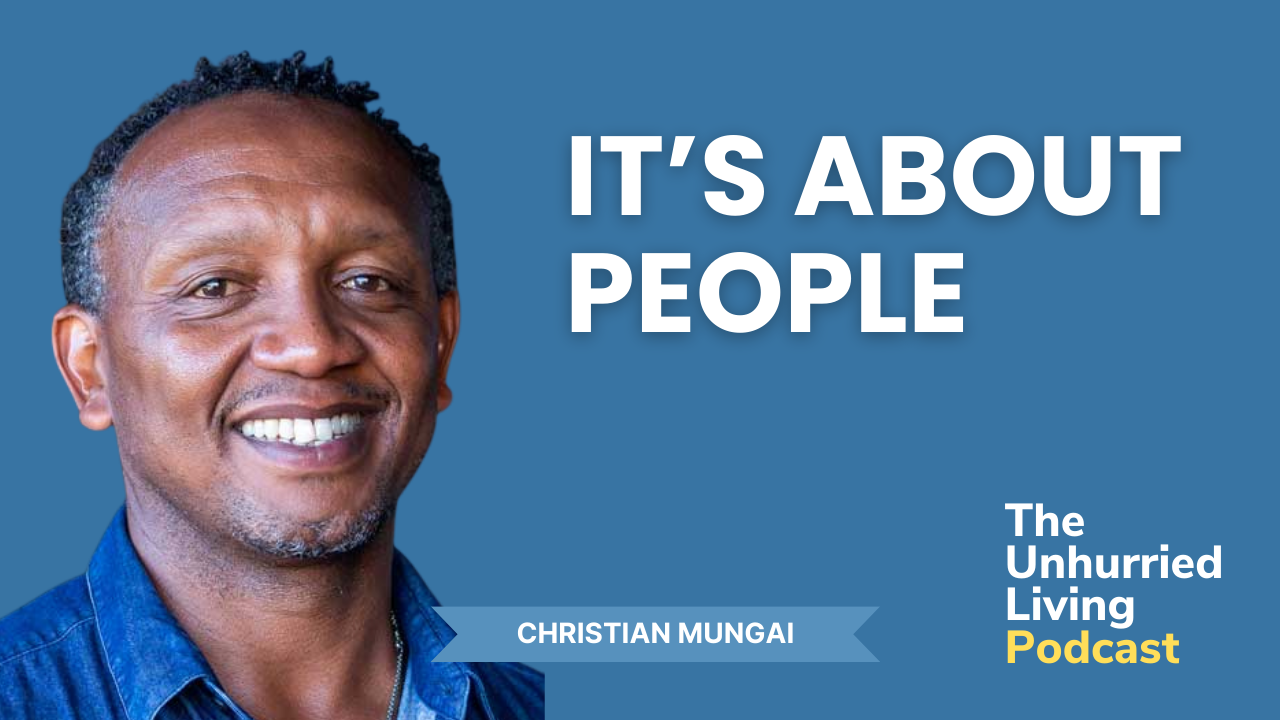
Blog by the Unhurried Living Team
In a world obsessed with Key Performance Indicators (KPIs), Return on Investment (ROI), and efficiency, the heart of Christian ministry often gets lost in the metrics. We measure success by how many wells were dug, how many events were held, or how quickly a project was completed. But what if our starting point for missions is wrong? What if the Western drive for "doing" is actually hindering the biblical mandate of "being"?
In a recent episode of the Unhurried Living Podcast, we sat down with Pastor Christian Mungai, a global leader, author, and bridge-builder, to discuss his groundbreaking book, People Are the Wealth.
Born in Kenya and serving for nearly two decades at Mariners Church in Southern California, Christian offers a paradigm-shifting perspective on faith, culture, and what it truly means to be a servant leader.
The Making of a Bridge Builder: "Gradually, Then Suddenly"
Christian Mungai’s story is one of duality. Born on the East side of Nairobi (a lower-income, marginalized area) but educated on the West side (among the country's wealthiest families), Christian grew up in a state of cultural limbo.
"I wasn't East enough for the East, and I wasn't West enough for the West. It inadvertently led to this life where I never belonged to either. And so I have become a bridge builder." — Christian Mungai
This unique upbringing prepared him for a life of connecting disparate worlds: multi-ethnic, multi-cultural, and multi-generational. However, this formation wasn't instant. Christian references the concept of "Gradually, then Suddenly," a phrase often attributed to Ernest Hemingway regarding bankruptcy, but equally applicable to spiritual formation. (Mark Batterson released a book entitled Gradually then Suddenly, and you can watch Alan’s interview with him HERE.)
The Spiritual Gym
Christian compares spiritual maturity to going to the gym. You don't lift weights for one day and wake up buff. It is a series of small, often unnoticed steps of obedience—a "gradual" process—that leads to a "sudden" realization of maturity.
- The Process: Daily faithfulness, small steps, unhurried obedience.
- The Result: A sudden realization that you are equipped for a calling you didn't see coming.
For Christian, the journey from a law student in India to an aspiring actor in America, and finally to a pastor in California, was the gradual work of God preparing him to bridge the gap between Western resources and African wisdom.
Rethinking Wealth: An African Perspective
The title of Mungai's book, People Are the Wealth, stems from an African proverb taught to him by his father. In the West, we often equate wealth with financial accumulation. In many African cultures, wealth is defined relationally.
The Distinction is Critical:
- Rich: Having money and material assets.
- Wealthy: Having a robust community and people around you.
Christian notes, "Money will make you rich, but it'll never make you wealthy... you're only as wealthy as the people you have around you."
This redefinition challenges the "Poverty of the West." While the West may have material abundance, there is often a poverty of community, isolation, and a transactional view of relationships. Conversely, those in materially poor nations may possess immense relational wealth. True global ministry requires recognizing that we are all poor in some areas and rich in others, leading to mutual reciprocity rather than a "savior" complex.
The Theology of Missions: The Three-Legged Stool
One of the most profound insights from the interview is Mungai’s critique of the current missional framework. Typically, missions organizations focus on two pillars:
- The Great Commission (Matthew 28): "Go and make disciples." (Evangelism)
- The Great Commandment (Matthew 22/25): "Love your neighbor." (Social Justice/Relief)
Christian argues that while these are vital, the "stool" is unstable without a third leg. If we only focus on these two, we risk viewing people as projects to be fixed or souls to be tallied.
The Third Leg: The Imago Dei (Image of God)
Mungai suggests we must go back before Matthew, all the way to Genesis. Before God created the earth, He existed in community (The Trinity—Father, Son, and Holy Spirit). We are created in that image.
- Inherent Worth: Every person has dignity simply because they exist, not because of what they can become or what we can do for them.
- The "We" Culture: The Bible was largely written to a collective "We," not an individualistic "Me." To fully understand God, we must embrace community.
By adding the doctrine of the Imago Dei as the third leg, missions shift from "fixing people" to "excavating the image of God" already present within them. As Christian beautifully puts it, quoting Michelangelo, our job is to chip away at the stone until the image reveals itself.
Western Efficiency vs. African Presence
One of the greatest points of friction in global missions is the concept of Time.
- The Western View: Time is a currency ("Time is money"). It must be spent efficiently. Being late is rude.
- The African View: Time is a resource for presence. Events start when people arrive. Being in a hurry is rude because it dishonors the person you are with.
Christian points out that the Western method is a gift—it brings accountability and efficiency. However, when exported without wisdom, it crushes relationships.
"In America, you ask someone 'What do you do?' to size them up. In Kenya, you ask 'Where are you from and who are your people?' If you tell me who your family is, I'll tell you who you are."
Moving from Event to Narrative
To practice "Unhurried Living" in missions, we must move from an Event-based mindset (checking a box, doing a project) to a Narrative-based mindset (entering a story).
Key Shifts for Modern Leaders:
- From Sending/Fixing →Listening/Learning: Stop assuming you have the solution.
- From Projects → Development: Projects inevitably end; development is sustainable change.
- From Self-Interest → Servant-hood: Are you doing this to feel good, or to actually serve?
The Hard Truth About Servant Leadership
"Servant Leadership" has become a buzzword in corporate and church circles. We love the title, but do we love the reality? Christian offers a piercing litmus test for leaders:
"You will know if you are a servant leader by how you react when you are treated like a servant."
If you claim to be a servant but get offended when you are not given the seat of honor, or when your expertise is ignored, you may be operating out of self-interest rather than servanthood.
Jesus is the ultimate model of this. He didn't rush. He spent 30 years in obscurity (the ultimate "waste" of ROI by Western standards) to fully acculturate and be human with us. He chose a "ragtag" group of disciples and spent three years doing life with them.
True servant leadership is:
- Catalytic: It speeds up a reaction but leaves no residue of itself.
- Invisible: It empowers the local people to be the heroes of their own story.
- Costly: It requires vulnerability and the willingness to be "weak."
Conclusion: Excavating the Image
Whether you are a pastor, a business leader, or someone looking to make a difference in the world, the call is the same: Slow down.
We must stop viewing people as problems to be solved and start seeing them as image-bearers to be discovered. When we operate out of a full heart—knowing who we are in God—we don't need to prove anything. We can simply be present.
As we bridge the gap between the efficiency of the West and the relational depth of the global South, we find a holistic, unhurried faith that doesn't just do good, but is good.
Key Takeaways
- Wealth is Relational: Financial poverty does not equal relational poverty. "People are the wealth."
- The Third Leg of Missions: Successful ministry requires the Great Commission, the Great Commandment, AND a high theology of the Image of God (Imago Dei).
- Time is for Presence: Shift your focus from "chronos" (clock time) to being fully present with the person in front of you.
- Catalytic Leadership: Great leaders empower others to solve their own problems, leaving no "residue" of ego or dependency.
Frequently Asked Questions (FAQ)
Q: What is the main premise of the book "People Are the Wealth"?
A: The book argues that we need to rethink the starting point of global missions. Instead of just "doing" (Great Commission) or "helping" (Great Commandment), we must start with the Imago Dei—recognizing the inherent worth and dignity of every person. It emphasizes that true wealth is found in community and relationships, not just financial resources.
Q: How does the African view of time differ from the Western view?
A: Western culture typically views time as a scarce resource to be managed for efficiency. African culture (and many majority world cultures) views time as a resource for building relationships. In this view, "wasting time" with people is actually the highest and best use of time.
Q: What is a "Catalytic Leader"?
A: According to Christian Mungai, a catalytic leader is someone who enters a situation to speed up a positive reaction (growth, change, development) but, like a chemical catalyst, remains distinct and eventually leaves no "residue" of themselves. This means the local community owns the success, not the outside leader.
Q: How can I apply "Unhurried Living" to missions?
A: By moving from an "event" mindset to a "narrative" mindset. Instead of rushing in to fix a problem and leave, take the time to listen, learn the culture, understand the family dynamics, and "excavate" the God-given potential in the people you are serving.

