
What to Do When Prayer Feels Boring
Apr 15, 2026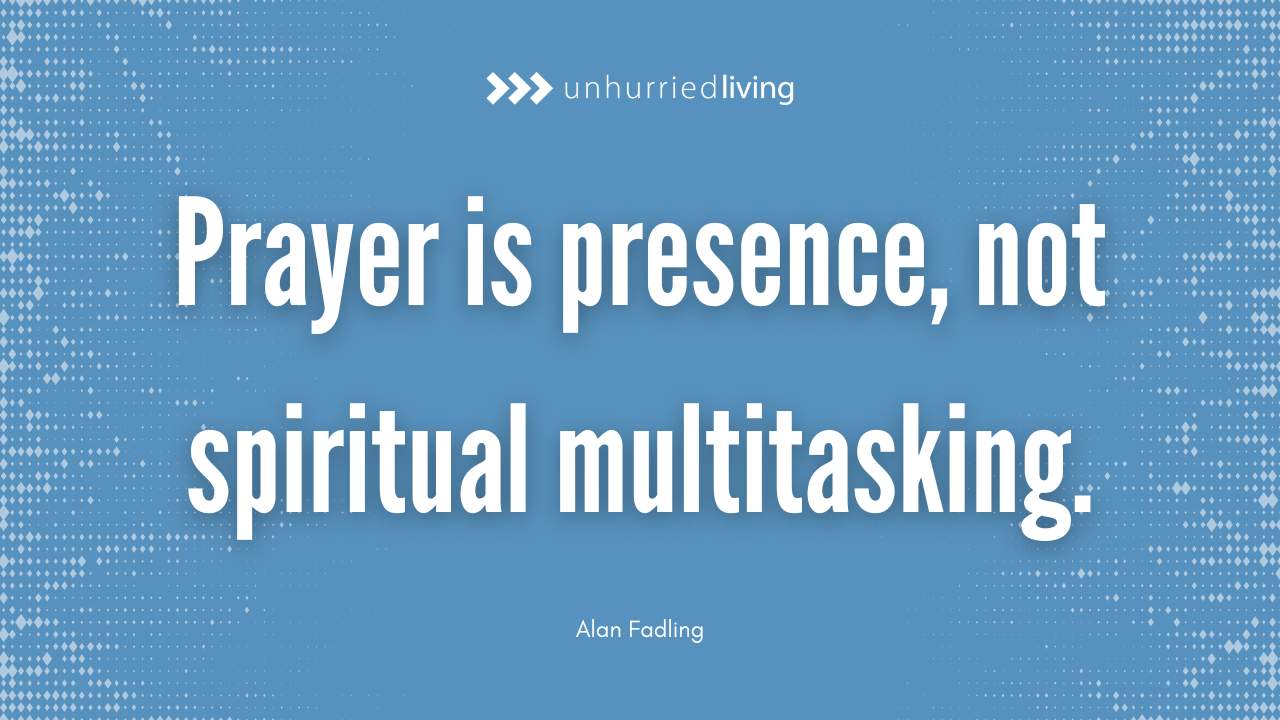
Blog by Alan Fadling
It’s tempting for us to assume that devotion deepens as prayer becomes more elaborate. We add layers, lists, and intentions, trusting that fullness comes from covering everything. But the soul does not flourish under that weight. It tires. Attention thins. Energy scatters. What began as desire slowly turns into duty.
Here again we draw, as we did two weeks ago, on the wisdom of Reginald Somerset Ward and his realism. He cautions against prayer that dissipates rather than gathers the heart:
“Too elaborate a programme of prayer, or the use of long lists of intercessions, soon lead to the weariness of dissipated energy.” (To Jerusalem, p. 158)*
Prayer is not an exercise in spiritual multitasking. It is an act of presence. Communion does not increase by saying more or saying it faster, but by consenting to God more fully in our prayer. A few points of loving attention are often enough to gather the heart and offer it to God.
I can exhaust myself by rehearsing words and concerns, moving faithfully down a list, and never actually arrive. True prayer happens when I stop managing the moment and allow myself to be with God. Fewer words. Fewer aims. A simpler rule. Not because God asks less of me, but because God desires all of me—and knows that a scattered soul cannot easily give itself.
This simplicity becomes especially important when prayer feels dull.
Ward names this sort of season in our life of prayer:
“All prayer, like all growth, is subject to variations of intensity. The dull period follows the bright as night follows day.” (To Jerusalem, p. 163)*
Human growth is not linear. We all have seasons of harvest and seasons of dormancy, seasons of visible growth and seasons that feel like decline. How might a tree feel as it loses its leaves rather than pushing out new ones? And yet I am tempted to judge these seasons by how they feel to me, sorting them too quickly into good and bad: I like this experience. I do not like that one.
Ward invites patience with the rhythms of the soul’s growth. Brightness gives way to dullness not because something has gone wrong, but because this is how living things grow. The danger comes when we interpret the dull season as failure and begin to mistrust the slow, hidden work that is still underway.
This is where his counsel about “outside helps” matters so much. A devotional book is not a crutch for weak prayers; it is a companion for weary seasons. When our own attention falters, the words of another can carry us for a while. They do not replace prayer. They lend their steadiness when ours is thin. Like a trellis supporting a vine in hard weather, such resources hold us facing God when our own attention cannot.
What does not help in these weary seasons is self-judgment. When prayer feels dull, we are tempted to withdraw, to try harder, or to abandon the practice altogether. But there is a gentler way: abide. Let God do his hidden work in you. Trust that even distracted prayer, when offered with humility, is still prayer.
The tree in winter is not failing to grow; it is deepening life. In the same way, these muted spiritual seasons may be doing a deeper work than we can feel, developing roots that will one day support new and surprising fruit.
For Reflection:
- Where have I been tempted to complicate my prayer life rather than simplify it?
- How do I typically interpret seasons when prayer feels dull or unproductive?
- What “outside helps” have steadied me in prayer during past weary seasons?
* R. Somerset Ward. To Jerusalem: Devotional Studies in Mystical Religion. Edited and introduction by Susan Howatch. Library of Anglican Spirituality. Mowbray, 1994.

