
Spiritual Rest Isn't Earned: What Israel's Calendar Shows
Sep 21, 2026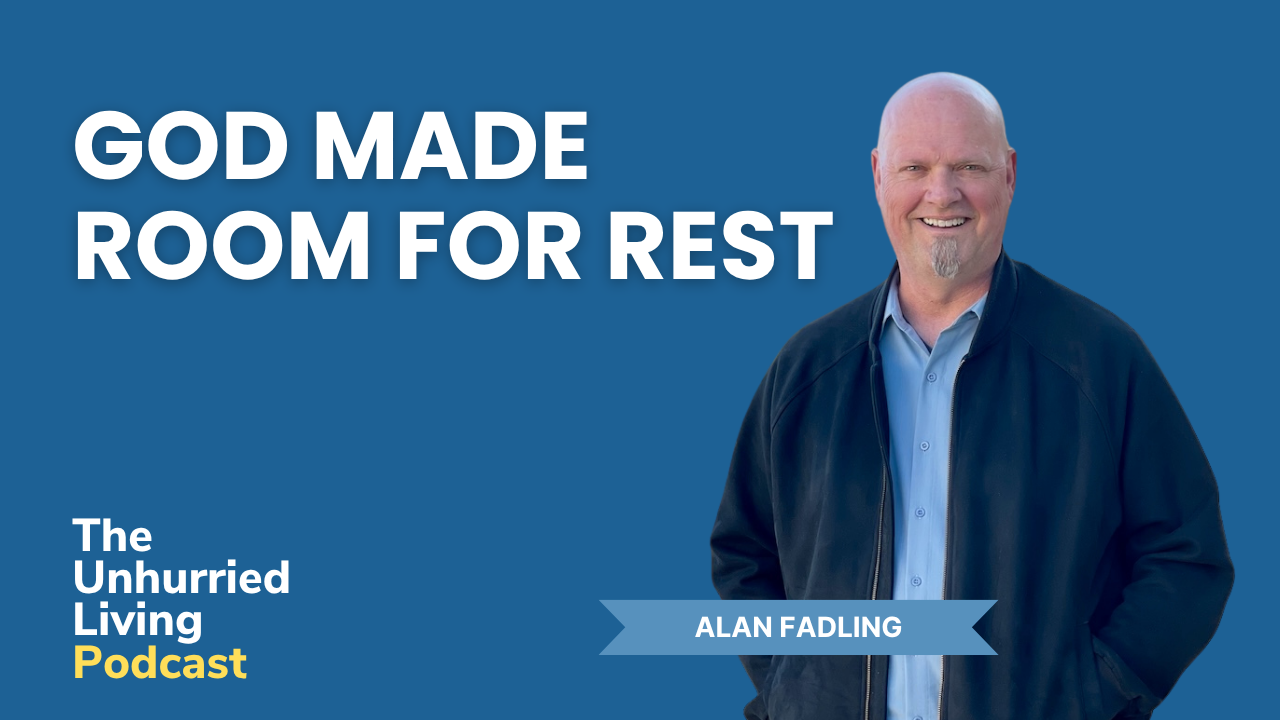
Blog by the Unhurried Living Team
Most of us assume rest has to be earned after the work is finally done. Alan Fadling, co-founder of Unhurried Living, asks a different question in this episode: how much time did God actually build into Israel's calendar for worship, rest, and celebration? The answer, once you count the Sabbaths, the festivals, and the sabbatical years, is startling.
Spiritual rest, it turns out, was never positioned as a reward. It was woven into the structure of ordinary life from the very beginning. Alan Fadling walks through the weekly Sabbath, the Sabbatical year, and the Jubilee, uncovering a pattern that reframes what work and rest were always meant to look like together.
This post unpacks that pattern in three parts: what it means to trust God's provision with your time, what unhurried living actually requires in practice, and what real Christian burnout recovery looks like when it starts before exhaustion rather than after it. Along the way, we will sit with a question Alan Fadling raises directly: do you trust God more than you trust your own ability to produce?
What Does Spiritual Rest Have to Do With Trusting God's Provision?
Alan Fadling begins with a simple exercise: counting the days. The weekly Sabbath alone accounts for roughly fifty-two days a year, a full day in seven set apart from ordinary work. Add the annual festivals described in Leviticus 23 (Passover, unleavened bread, weeks, trumpets, the Day of Atonement, and tabernacles) and Israel's calendar was already asking for another week of sacred time.
Then came the new moon celebrations, twelve times a year, and the sabbatical year itself, when fields were left unsown and vineyards unpruned. Fields going untended for an entire growing season is not a small ask. It requires trusting God's provision in a way that ordinary planning and effort cannot replace.
Alan Fadling is honest that this trust did not come easily for Israel. Scripture records surprisingly little evidence that the sabbatical year or the Jubilee were ever consistently observed. The chronicler later notes, in 2 Chronicles 36, that the land finally received the Sabbaths it had long been denied.
That detail matters more than it might first appear. We often picture sin mainly in terms of broken commandments; idolatry, injustice, open rebellion. Alan Fadling points to a quieter, less obvious form of unfaithfulness woven through Israel's story: the simple inability to stop, to trust God's provision enough to let productive work rest for a season.
One small step: this week, choose a single ordinary task and set it down a day early, not because the work is finished, but as a practice of trusting God's provision instead of your own effort.
If you are wrestling with what it means to actually trust God with your time, a soul care guide can help you think it through. connect here to talk with a trained guide about what trust and rest could look like in your own life.
How Do You Practice Unhurried Living in a Culture of Hurry?
Unhurried living was never meant to stay theoretical for Alan and Gem. Alan describes what he calls the one-third rule, drawn directly from noticing that nearly a third of Israel's calendar was set aside for worship, rest, and remembrance. People are transformed less by information and more by having enough unhurried space to actually practice what they are learning.
That conviction is why Alan and Gem built the PACE cohorts. Rather than another program that adds more content to an already full life, PACE creates extended space for leaders to practice unhurried living with God alongside others seeking the same thing. It is a practical answer to a question many tired leaders carry quietly: how do you learn a new rhythm instead of just hearing about one.
Unhurried living, in this sense, is less a mood and more a structure, something built into a calendar rather than hoped for in a spare moment. Israel's rhythms were not occasional escapes from real life. They were the ordinary shape that a trusting, spacious life was meant to take.
One small step: block thirty unhurried minutes on your calendar this week with no agenda except being with God, and protect it the way you would protect any other commitment.
When you are ready to explore what sustained, unhurried practice with others could look like, explore it here and see whether PACE might be a next step for you.
What Does Christian Burnout Recovery Actually Require?
Most approaches to Christian burnout recovery start after the damage is already done: a sabbatical, a retreat, a season of forced slowing down once the body or the calling gives out. Alan points to something different in Israel's design. God's rhythms of rest were not recovery after exhaustion; they were a structure meant to keep exhaustion from becoming normal in the first place.
Alan names the modern version of this plainly. A "burnout economy" now sells sleep-focused vacations and executive coaching to help exhausted professionals recover the attention and margin that relentless productivity took from them in the first place. Rest has become a purchased commodity rather than a practiced rhythm.
The deeper issue, Alan suggests, is not a scheduling problem but a trust problem. Israel struggled to believe that stopping would not cost them everything, and many leaders carry the same quiet fear today. Christian burnout recovery, then, is less about a single getaway and more about relearning that your worth was never tied to your output.
Consider the arc of the episode itself. Alan traces the Sabbath command all the way back to Egypt, where Pharaoh demanded bricks and eventually took away the straw, a system that always asked for more. When Moses later repeats the Sabbath command in Deuteronomy 5, he ties it directly to that deliverance, reminding Israel they were once slaves.
Slaves do not get Sabbaths; free people do. Learning to receive that freedom, Alan suggests, is at the center of genuine Christian burnout recovery.
One small step: name one belief driving your own resistance to rest, whether it is fear of falling behind or fear of being unnecessary, and bring that single belief honestly to God this week.
How Do Biblical Rhythms of Rest Teach Us to Trust God?
Israel's calendar suggests that trusting God through biblical rhythms of rest was never meant to be occasional. The table below contrasts the assumption many leaders carry today with what Israel's design actually communicated.
|
Common Assumption |
What Israel's Calendar Reveals |
|
Rest is earned after the work is finished |
Rest was built into the structure before the work began |
|
Stopping means falling behind |
Stopping was how a free people practiced trust |
|
Productivity proves your worth |
Provision was never tied to your output |
|
Sabbath is a modern wellness idea |
Sabbath was a deliverance practice rooted in Exodus |
Across the Sabbath, the festivals, the sabbatical year, and the Jubilee, a consistent pattern of biblical rhythms of rest emerges: worship, trust, gratitude, and enoughness, repeated often enough to reshape a whole people. Alan Fadling notes that Jesus later stands in the synagogue in Nazareth and announces good news for the poor and release for the captives, language many scholars hear as echoing Jubilee itself, as though the rest Israel could never quite receive was finally arriving in him.
Who Is This Invitation For?
This message was not written for one city or region. Unhurried Living exists for tired leaders wherever they are serving, whether in a small congregation, a growing nonprofit, or a kitchen table staff meeting held over video call. The exhaustion Alan Fadling describes does not respect borders, and neither does the invitation to rest.
Leaders in more than 145 nations already listen to this podcast each week, carrying different titles and different pressures but the same quiet weariness. Wherever you are reading this, you are welcome into this same unhurried rhythm alongside them.
What Would It Look Like to Trust God With Your Rest?
Israel's calendar was never designed to burden its people with more obligation. It was designed to teach them, week after week and season after season, that they were not what they produced and that God could be trusted. Spiritual rest was the ordinary shape a free people's life was meant to take, not a reward waiting at the far end of enough work.
Unhurried Living exists to help tired leaders practice that same trust today, and sign up here for the Weekly Email if you want ongoing encouragement toward a more spacious life. If you would rather start with something daily, start here with the Unhurried Daily Email, a forty-day devotional built for exactly this kind of unlearning.
Frequently Asked Questions
Q: How much time did God set aside for rest? A: Alan Fadling counts roughly fifty-two Sabbath days, another week of annual festivals, twelve new moon celebrations, and a full sabbatical year, adding up to nearly a third of Israel's calendar devoted to worship, rest, and remembrance.
Q: Why is it so hard to stop working and rest? A: Scripture suggests the struggle is less about scheduling and more about trust; stopping asks a person to believe that provision does not depend entirely on their own effort, which is a hard belief to hold onto.
Q: What did Old Testament Sabbath laws mean for rest? A: The weekly Sabbath, the sabbatical year, and the Jubilee were not restrictions tacked onto Israel's life. They were meant as protective boundaries that trained a delivered people to live as free people rather than as slaves to constant production.
Q: Why did Israel struggle to observe the sabbatical year and Jubilee? A: The biblical record shows little evidence either was consistently practiced, and 2 Chronicles 36 notes the land finally received the Sabbaths it had long been denied during the Babylonian exile, suggesting Israel's ongoing struggle to trust God enough to stop.
Q: How does Jesus relate to the rest Israel could not fully receive? A: When Jesus stood in the synagogue in Nazareth and announced good news for the poor and freedom for the captives, many hear echoes of Jubilee in that declaration, as though Jesus were announcing the arrival of the rest Israel had long awaited.

