
When It Feels Like Everything Depends on You
Sep 02, 2026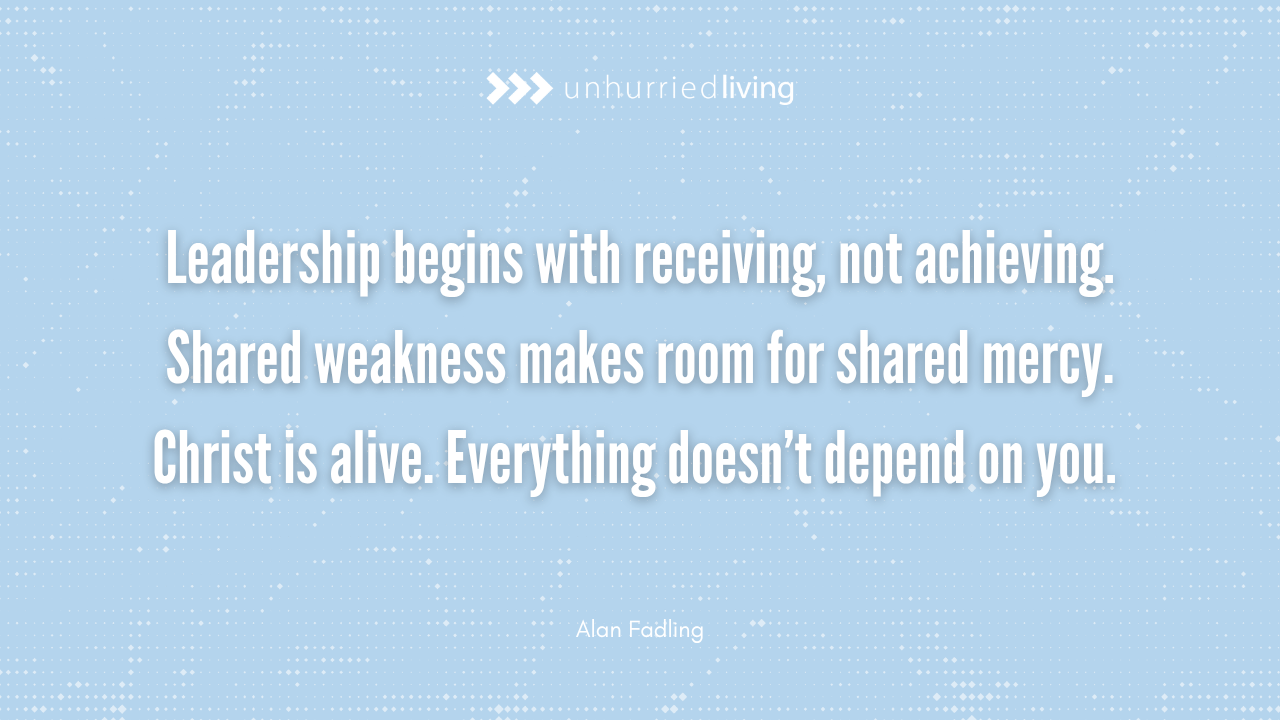
Blog by Alan Fadling
In 1996, seven Trappist monks were martyred in Algeria. One of them described his calling this way: “A monk is simply a sinner who joins a community of sinners who are confident in God’s mercy and who strive to recognize their weaknesses in the presence of their brothers.”
That vision is not just for monks—it is for the whole church.
Strength is easy to admire. Honesty is harder.
Shared weakness is not the story Americans tell about leadership. We value personal strength. We admire competence, confidence, and visible, measurable success. And we are not always sure we want to share even our strengths with anyone else, let alone our weaknesses.
But the gospel begins somewhere else. It begins with confession. With need. With mercy.
Christian leaders are still sinners in need of mercy and grace. I have been a Christian leader my whole adult life, and I feel my need for mercy more deeply today than ever.
In recovery groups, I have witnessed something quietly transformative. Men and women introduce themselves not with their achievements but with the truth of their stories. They name their need. They confess their brokenness. And together they learn to trust that a merciful God is truly present among them. He doesn’t wait until after they improve but is right there with them in their vulnerable honesty.
It requires real courage to embrace this kind of leadership in a culture that prizes impressive competence over honest confession. The leaders who endure are not those who have mastered the illusion of self-sufficiency but those who have learned how to receive mercy.
A Living Christ, Not a Managed Memory
Such honesty only works if mercy is more than an idea. It only works if God is not distant, not theoretical, not waiting for us to get our act together. Shared weakness would be crushing if all we had was a memory of what Jesus once did. It would leave us trying to manage a legacy, trying to keep something alive through our own efforts.
Our faith rests on more than the memory of Christ’s life; it is dependent on his present life among us. And Christian leadership is not primarily our effort for him. It is our openness to what the living Jesus longs to do within us and through us.
Andrew Murray once asked a piercing question in a little book titled Jesus Himself:
“What is the difference between a dead Christ, whom the women went to anoint, and a living Christ? A dead Christ, I must do everything for; a living Christ does everything for me.”*
Murray is picturing that quiet Sunday morning between crucifixion and resurrection — when the women went to anoint a dead body. In that moment, love looked like tending something lifeless. Caring for what could no longer act. Honoring what once was but was no longer.
And if we are not careful, that is how our faith can begin to feel. We admire Jesus. We serve his mission. We intend to carry his work forward. But underneath it all, there can be a subtle assumption that everything now depends on us. That we must keep the movement alive. That we must compensate for our weakness by working harder for him.
But shared weakness only makes sense if Christ is not a memory we maintain but a Presence who moves among us.
If Jesus is alive — truly living and risen and at work — then weakness is no longer a liability. It becomes the place where Jesus meets us. I am not tending a body in a tomb; I am walking with a risen Lord. I am not preserving a legacy; I am participating in a life Jesus has invited me into.
The writer of Hebrews tells us that the Word of God is living and active. Those words describe more than just a leatherbound book; the Word is the Son himself—present, speaking, acting. The question for me is not simply what I will do for God today. The deeper question is whether I will recognize what the living Christ is already doing.
I find myself praying: “Lord, awaken my heart to this. Free me from the exhausting illusion that everything depends on me. Teach me to notice you at work. Let my leadership, my service, even my repentance, begin not with my effort for you but with your life in me.”
Perhaps this is what makes a community of shared weakness possible. We do not bring our weakness into an empty room. We bring it into the presence of the living Christ. And there, weakness becomes not something we must hide from one another but a place where together we can receive mercy.
For Reflection:
- Where might you be working to appear strong, capable, or self-sufficient right now? What would it look like to bring your weakness honestly into the presence of Christ and perhaps a trusted friend?
- Where have you been living as though everything depends on you? Take a few quiet moments to become aware of the living Christ with you there. What mercy, help, or grace might he be inviting you to receive?
* Andrew Murray, Jesus Himself (New York: Revell, 1893), p. 1.

Alan Fadling (MDiv) is a founding partner of Unhurried Living, Inc. in Mission Viejo, CA. He writes and speaks as an expert in the challenge of hurry in contemporary life and work and how to overcome it. He consults and coaches leaders and their organizations in the U.S. and around the world, helping them work towards long-term productivity that lasts rather than settling for quick fixes that don’t. Alan co-leads PACE, a two-year leadership formation journey that helps leaders live and lead from spiritual depth rather than depletion. He is the award-winning author of six books including An Unhurried Life, An Unhurried Leader and A Non-Anxious Life. To connect with Alan and find resources for soul care and leadership, visit unhurriedliving.com or find him on LinkedIn.

