
You Don’t Have to Make It Grow
Oct 14, 2026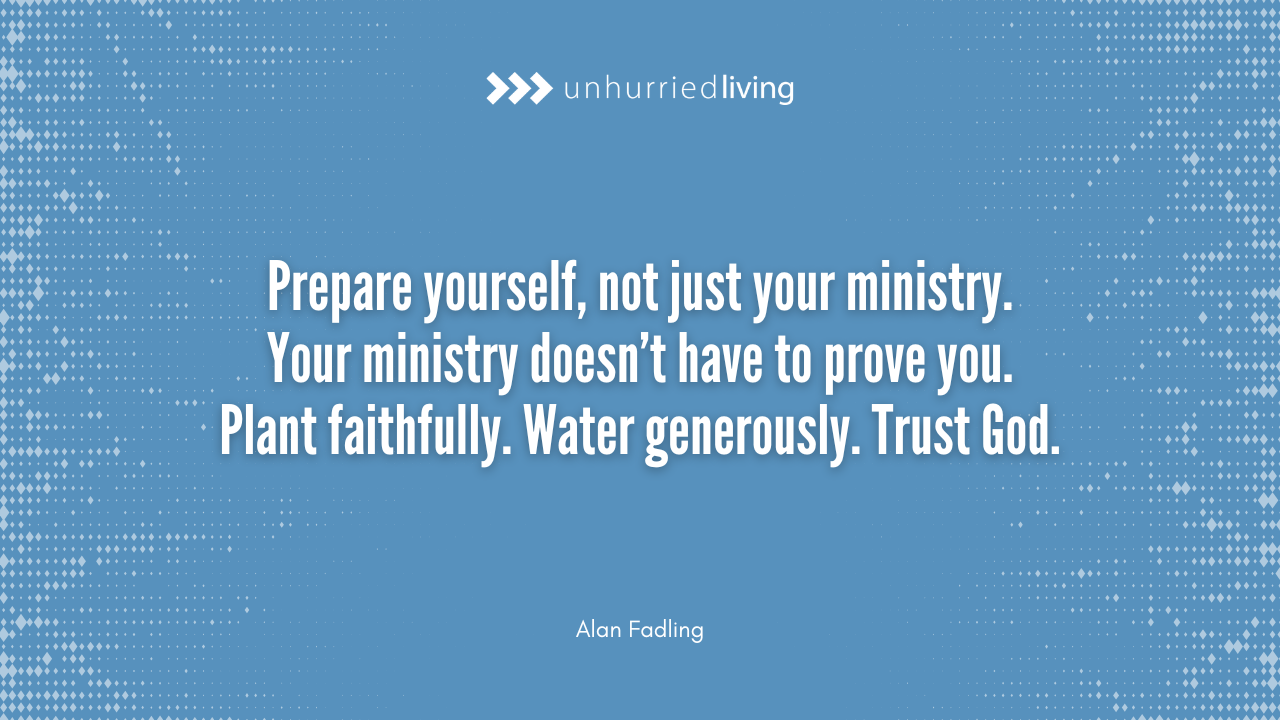
Blog by Alan Fadling
Over the years, I’ve noticed that one of the most important transformations in leadership is not something that happens in our strategies or structures but something that happens in who we are becoming. I’ve come to think of it as the inner conversion of a leader.
Conversion is not only the doorway into salvation. It is also the ongoing way that salvation reshapes every area of our lives—including our leadership. Part of a leader’s conversion involves a transformed understanding of what our leadership is meant to produce in the kingdom of God.
Preparing Ministries, or Preparing Myself for Ministry?
Once, as I was speaking to a group of church leaders, I found myself asking an unexpected question. It wasn’t something I had written in my notes. I said, “This may be a silly way to ask it, but what is our product? What do we actually produce? What are we ‘selling’?” In other words, what is the primary good our leadership is meant to produce?
One of my mentors would typically ask one of two questions whenever we gathered for leadership meetings: “What is the Christian life?” and “What is the church?” At first, those questions felt almost elementary, as if we were being asked something we should have settled long ago.
But the longer I live, the more I believe these are essential questions. What is our vision of the Christian life? How do we live this life well? And how do we live it together as God’s people, the church?
What I have come to realize is that I want to live the gospel so well that my life recommends my message. I want my life to be richly “gospeled.” I want my life to feel more like good news than bad news to the people who cross my path.
As I spoke to that room full of church leaders, I observed that they were responsible for many things—programs, structures, job descriptions, departments, and more. But what makes any of those things meaningful is the way they serve actual people. The fruit that Jesus invites us to bear—the fruit that lasts—always involves people.
So when I think about ministry and serving with excellence, I certainly work to be well prepared when I speak, lead an event, and counsel or coach someone. But at the center of all that preparation is something deeper: the preparation of myself. Who I am when I preach, teach, or lead makes an immense difference.
Do I enter a ministry moment anxious or at peace? Do I arrive frustrated or grateful? Do people experience me as running ahead of them or present with them? In what ways is the living presence of Jesus overflowing my life in what I say and do? Is that what people encounter in their experience of my leadership?
I ask these questions not to give myself a guilt trip but to deepen my awareness of God with me.
I believe Jesus invites us to be coached by him in the ministries he has entrusted to us. He is the Great Shepherd. He knows what he’s doing. He knows what matters and what doesn’t. I want to learn how to walk with him and work more closely with him. That has been my quest for most of my adult life as a Christian leader.
As we begin to pay attention to our inner life in leadership, we may start to notice something uncomfortable. The work we once assumed was purely for others often turns out to have been quietly serving us as well. Our ministries can become places where we seek recognition, prove our worth, or feel needed by others. The Jesuit writer Thomas Green once named these hidden dynamics with unusual honesty. His words help us see how prayer slowly exposes the subtle ways our leadership can revolve around ourselves rather than around the people we are meant to serve.
From Self-Centered to Other-Centered Ministry
Green describes how a change in our life of prayer can lead to a change in our leadership:
“And such a tremendous change in our prayer cannot but effect a comparable change in our lives. Our apostolate, our ministry, our service of others also becomes more other-centered and less self-centered. We begin to realize how all our generous and apostolic actions have been tainted by seeking for recognition, by a need to prove our own worth, and perhaps our superiority to others, ...and by a desire to find our fulfillment in others’ dependence on us.”*
Here Green speaks to the integration of our inner life of prayer and our outer life of work or leadership. One evidence of this integration is the gradual diminishing of the subtle ways we engage in our work to serve our own needs rather than the needs of others.
I’ve seen the self-serving motives Green names both in myself and in others: seeking recognition, proving our worth through what we accomplish, quietly feeling more serious or committed in our spirituality than others, or even finding satisfaction in the dependence people have on us.
This brings to mind Paul’s words in 1 Corinthians 3:6-7, where he says, “I planted the seed, Apollos watered it, but God has been making it grow. So neither the one who plants nor the one who waters is anything, but only God, who makes things grow.”
It really is true that we each make our contribution through what we initiate in planting or cultivate through watering. But in the end, it is God who gives growth and makes our work fruitful. We did not create the seeds—He did. We simply plant and water what he has already given.
Perhaps this is part of the inner conversion of a leader: learning to offer faithfully what is ours to give while trusting God with the growth only he can give.
For Reflection:
- Where might your leadership be serving your own need for recognition, worth, or being needed? What might Jesus want to give you there instead?
- What has God given you to plant or water in this season? Where might you be invited to trust him with the growth?
(Purchases made via the links may provide an Amazon Affiliate commission fee to Unhurried Living. This adds nothing to the cost of your purchase).
*Thomas H. Green, When the Well Runs Dry (Ave Maria Press, 1979), p. 158.

Alan Fadling (MDiv) is a founding partner of Unhurried Living, Inc. in Mission Viejo, CA. He writes and speaks as an expert in the challenge of hurry in contemporary life and work and how to overcome it. He consults and coaches leaders and their organizations in the U.S. and around the world, helping them work towards long-term productivity that lasts rather than settling for quick fixes that don’t. Alan co-leads PACE, a two-year leadership formation journey that helps leaders live and lead from spiritual depth rather than depletion. He is the award-winning author of six books including An Unhurried Life, An Unhurried Leader and A Non-Anxious Life. To connect with Alan and find resources for soul care and leadership, visit unhurriedliving.com or find him on LinkedIn.

